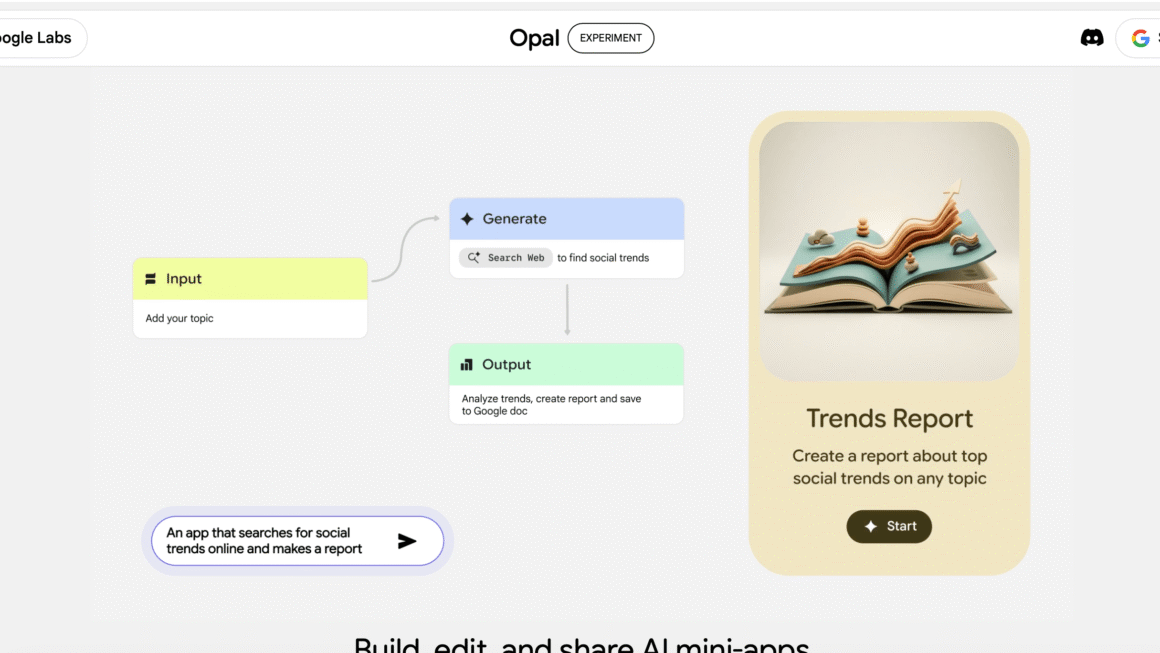
Opal Ai is Google Labs’ experimental tool for creating AI mini-apps with natural language. Instead of writing code, users describe the workflow they want to build. The platform then turns that description into a multi-step AI application. Therefore, users can move from an idea to a working prototype much faster.
What Is Opal Ai?
Opal Ai focuses on building small, useful AI applications rather than traditional websites. Users describe a task, and the system creates a workflow around that task. Each workflow can contain several connected steps for different parts of the process. Moreover, users can inspect those steps and adjust them when needed.
Google designed the tool around natural language, so coding knowledge is not essential. However, complex workflows may still require editing and testing. As a result, users need to understand the problem they want to solve.
How Does It Work?
The process begins with a simple description of the desired application. Users explain the task, expected output, and useful behaviour. The system then generates a workflow and provides a preview of the resulting mini-app. Users can test the application before deciding whether changes are necessary.
The workflow can include multiple AI actions. For example, one step might analyse uploaded information. Another could transform that information into a structured result. A later step might generate text, images, or another useful output.
Users can also describe changes using natural language. Therefore, experimentation becomes easier for non-technical users.
What Can You Build?
The strongest use cases involve tasks with clear inputs and outputs. For instance, a creator could turn research notes into content ideas. Similarly, a marketer could create a workflow for analysing campaign information.
Possible examples include:
- Content planning assistants
- Research and summarisation tools
- Study guide generators
- Marketing workflow assistants
- Image and text generation tools
- Document processing workflows
- Productivity tools
However, users should avoid treating every idea as a suitable mini-app. Simple, repeatable tasks usually produce better results. Complicated systems may need dedicated software instead.
AI Workflows Instead of Simple Chats
The biggest difference involves workflows rather than ordinary chat conversations. A standard chatbot responds to individual prompts. Opal Ai can connect several actions into one repeatable process.
Imagine uploading lecture notes and requesting a study package. The workflow could analyse the notes first. Then, it could create a study guide from the extracted information. Finally, it could generate supporting images or other learning materials.
This approach reduces repeated prompting. Consequently, users can turn recurring tasks into reusable tools.
Editing and Sharing Mini-Apps
Creating an application does not have to end with the first generated version. Users can inspect the workflow and request specific changes. They can also remix existing mini-apps and adapt them for different purposes.
For example, a content tool might initially generate social media ideas. Users could modify it for platform-specific formats or different tones.
Furthermore, users can share completed mini-apps with other people. Depending on settings, an application can remain private or become accessible through a link.
Who Should Use It?
Opal Ai can suit people who want practical AI automation without learning traditional programming. Marketers, educators, researchers, creators, and small teams can explore applications.
For businesses, the biggest advantage comes from rapid experimentation. Teams can test ideas before investing in larger custom applications.
However, businesses should not confuse rapid prototyping with complete software development. Production systems often require stronger security, integrations, databases, permissions, and monitoring. Those requirements can exceed what a lightweight AI mini-app should handle.
Is Opal Ai Worth Trying?
For experimentation, Opal Ai offers a practical way to understand AI workflows. It lowers the technical barrier and encourages people to build rather than simply chat. Additionally, its visual workflow approach makes the underlying process easier to understand.
Google describes Opal as an experimental Google Labs project. Therefore, features and capabilities may evolve over time.
Liaise Platform sees tools like this as part of a broader shift toward accessible AI creation. Yet, the technology itself is not the main advantage. The real value comes from finding repetitive problems and designing useful solutions.
Getting Started
Start with one specific problem rather than a large application idea. Explain what users should provide and what the application should produce. Then, review the generated workflow carefully.
Test the application with different examples before sharing it. If results feel inconsistent, improve the instructions and workflow steps. Likewise, remove unnecessary actions that make the process more complicated.
Most importantly, focus on usefulness instead of novelty. A simple tool that saves time can create more practical value.
The Future of AI Mini-Apps
AI tools are moving beyond simple question-and-answer experiences. Increasingly, they can coordinate multiple steps and produce complete outcomes. Opal Ai reflects that shift by turning natural language into reusable AI workflows.
The bigger opportunity is not replacing every traditional application. Instead, it gives more people a faster way to test ideas.
As these tools mature, AI mini-apps could become common parts of everyday digital work. For now, their greatest strength remains simple: turning a clear idea into something people can actually use.